The Visual Meaning of a Day
Every night, Virtues writes the biography of your day. It resolves the people you spoke with, threads your events into a timeline, and reconstructs the full W5H — who, what, where, when, why, how. By the time it finishes, it holds the most complete account of your Tuesday in existence, and over time, your life.
Today began on the South Bank, just after seven, where you met Maya1 for an early coffee before the crowds. You walked the river east, rented kayaks below Tower Bridge, and spent the better part of the morning on the water. By noon the weather had turned, so you caught the early train home — quiet, sun-tired, content.

- where South Bank
- where Tower Bridge
- what kayaking
- topic a coffee date
- 07:42 Coffee with Maya Watch House · South Bank
- 09:15 Rented kayaks below Tower Bridge
- 12:10 Train home Northern line · sun-tired
- … +11 more events
But a biography is prose and a timeline is a list. You must read every line of both to understand your day’s narrative arc — whether it held together or came apart, whether it moved like a melody or a ten-car pile-up.
This presented a unique design problem. What is the lightest possible way to render the shape of a day? We needed something legible at a glance but deeply explainable when pushed. It had to be honest enough to reflect nuance without relying on naive LLM interpretations. Most importantly, it had to capture the interplay of time, the body, and the sheer newness of a day—without letting any single metric dominate the canvas.
The Phenomenology of a Good Day
“The books or the music in which we thought the beauty was located will betray us if we trust to them; it was not in them, it only came through them, and what came through them was longing.” — C.S. Lewis, The Weight of Glory
Ask yourself this seriously: what makes a good day for you?
What makes something good at all
Shakespeare’s eighteenth sonnet is fourteen lines of near-perfect iambic pentameter. But none of the sonnet’s form tells you why the poem has outlived the summer afternoon it compares her to. The greatness doesn’t sit in the meter or the word count; it comes through them. The greatness lives in the context—the who, the why, the what, etc. Goodness was never a quantity. It’s the way a thing shines when it becomes what it was meant to be.
There is a reason the countable parts never add up to the thing itself, and C.S. Lewis gave it a name: transposition. When a richer, higher reality is forced down into a poorer medium, it has to reuse the same signs. Joy and grief are complete opposites in the mind, but in the body, they produce the exact same result: tears. If you measure only the saltwater on the cheeks, you will conclude that a wedding and a funeral are the same event.
The Prudence of a Day
Even if a number could somehow read how a moment felt, it still wouldn’t tell you whether the day was good—because “good” refuses to hold still. An empty Saturday with the phone face-down is a triumph for the father trying to finish his novel, and a quiet ache for the twenty-four-year-old hoping this is the year she meets her husband.
The goodness of a day lives in whether we did what the day actually asked of us — the right thing, in the right place, at the right time. That is the oldest definition of prudence: not caution, but the practical wisdom to read what this particular moment calls for. It is a virtue of particulars, which is precisely why no universal rubric can score it.
There is a mercy in the fact that we can’t deterministically compute goodness. If we could, it would strip away our human dignity—our need to develop discernment, to feel the friction of our choices, and to find peace without having all the answers. A lived day is phenomenological; it is not a bug that it resists being reduced to a score, that is the thing worth protecting.
The False Start: From 1024 Dimensions to a Pretty Cloud
All of this steers us away from prescribing axes—away from the arrogance of plotting a human life on a “productivity” or “chaos” scale. So our first instinct was to lunge the other way: prescribe nothing, and let the data organize itself. Mathematically, that means dimensional reduction.
We take the day’s data—around 8 to 16 salient “events” (the anchors), a handful of topics and entities (the glue), and 50 to 150 background data points like messages, steps, and app usage (the ambient dust)—and we embed them. The raw data first runs through event classification a process where an LLM reads the digital ‘clues’ in your raw daily data and resolves them into coherent events, like a high-fidelity 24-hour calendar, and then a dedicated embedding model converts every action into a 1024-dimensional vector: an array of numbers that captures its semantic essence.
“A calm, focused morning of deep work at home — drafting the Q3 architecture document alongside a cup of coffee and classical music.”
To collapse those 1024 dimensions into something a human can actually look at, we use UMAP (Uniform Manifold Approximation and Projection) to project them into a 3D space. In the resulting constellation there is no “Time” or “Stress” axis—space equals meaning. The closer two stars sit, the more semantically related they are; and as the day streams in, the cloud shifts and breathes, settling by midnight into its final shape.
[ THE PRETTY, MUTE CLOUD GOES HERE ]
And it was beautiful. It was also mute. On first glance, a UMAP cloud tells you nothing—it is a black box you have to interrogate one question at a time. To pull a single grain of meaning out of it, you have to click two stars and compute the cosine similarity of their original, high-dimensional vectors:
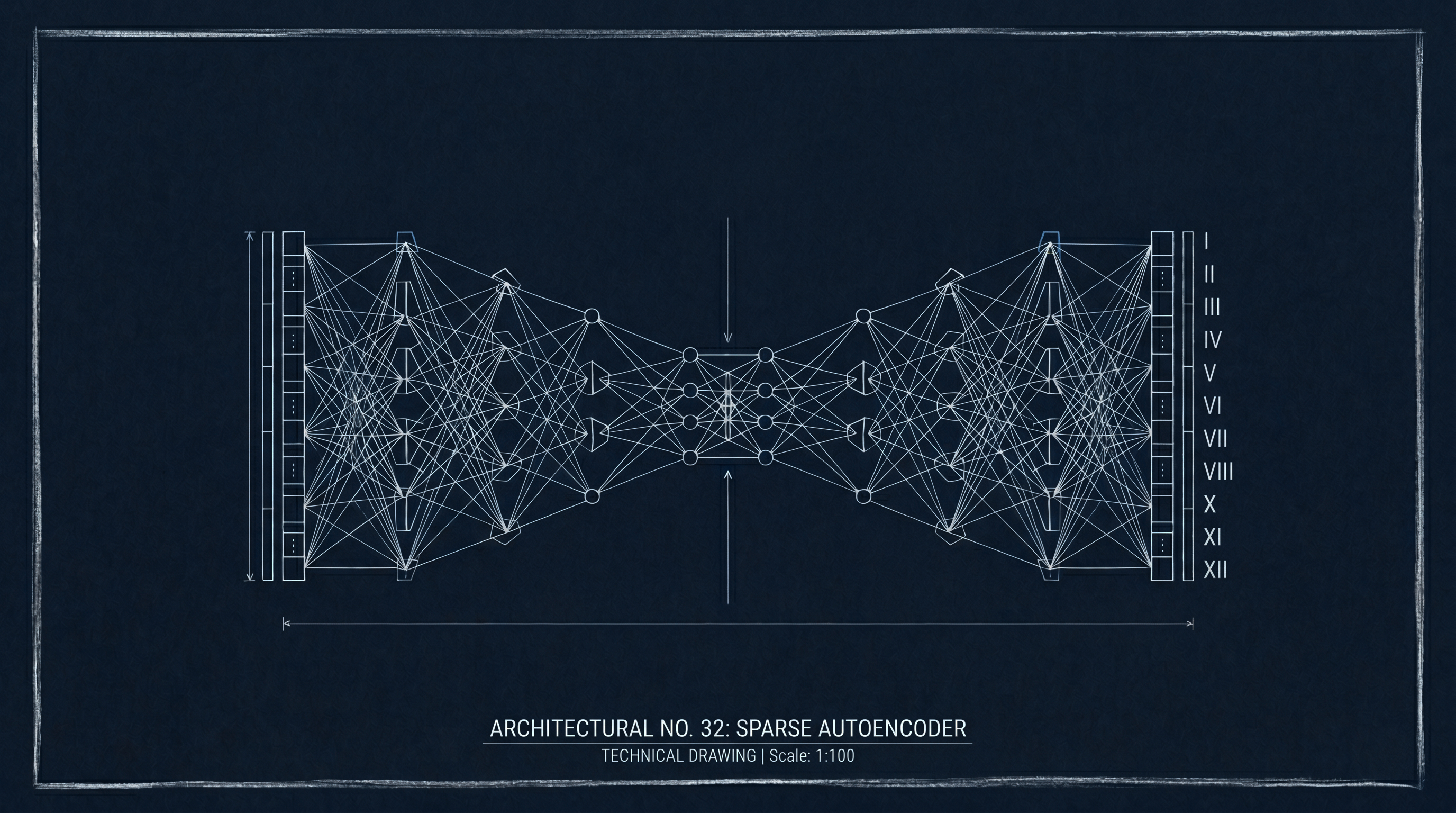
Even then the answer betrays you, because dense embeddings are polysemantic: “Dimension 432” might encode financial transactions and interpersonal anger at the very same time. So we went further down the rabbit hole. To decode the space, we started training our own Sparse Autoencoder (SAE) directly on top of the embeddings.
Here we caught a lucky break. A dense embedding is already a compressed thing—the meaning is packed tight. So unlike a full language model, which has to fan a layer out by 32× to pry its tangled concepts apart, our SAE only needs to expand by 4–8×. That leaves a few thousand clean features instead of hundreds of thousands: small enough to train on a laptop, in an afternoon, on nothing but human behavior.
Internally, we call this the HASAE—the Human Action Sparse Autoencoder—because every engineering team needs an acronym to make their science experiments sound official.
And the autoencoder works. Trained only on human action, it promises a kind of Rosetta Stone for behavior—telling us that Feature #1042 is “Interpersonal Friction” and Feature #89 is “Domestic Routine.”
If I’m honest, that was most of the appeal. I was far more excited to train a sparse autoencoder than to work out what one would ever mean for the person actually staring at their day—which is, I’m reliably told, the oldest failure mode there is: the engineer who falls for the instrument and forgets the problem it was built to serve.
And somewhere in the middle of building it, the realization caught up with the excitement. We had taken the meaning we had already built—the resolved events, the who and the what and the why—and dissolved it back into a dust we now needed forensic science to read. We had knocked down the house to admire its rubble, then hired investigators to tell us which room we were standing in. The cloud was pretty. It was not legible, it was not comprehensive, and it was not honest at a glance.
The autoencoder isn’t wrong, to be clear—it is a genuinely thrilling instrument. It is just built for a different journey. Decoding the slow trajectory of a life across years is a measurement problem an SAE is perfect for; reading the shape of a single Tuesday is not. So we set it down, and went back to the two things we had been so eager to throw away.
The Shape of a Day
There were two ditches, it turned out, not one. On the far side lay the scoreboard—the productivity rubric that pretends to grade a life. On the near side, where we had just been standing, lay the mute cloud—so terrified of judging the day that it refused to say anything at all. The road between them was narrower, and more obvious, than either: keep the meaning we had already built, and measure only what can be measured honestly—never the good, only its substrate.
The events were already the meaning. Time was already the spine. We had dissolved both in the name of cleverness; the fix was simply to stop.
So time goes back where it belongs—on the X-axis, real wall-clock time, where the empty hours are allowed to stay empty. Dead time is data: the long, flat, phone-face-down stretch is the entire point of the novelist’s good Saturday.
The height of the line is the body. It rises and falls with your activation—how stirred or settled you were—read against your own resting floor, the dashed baseline. Not a productivity score; an honest autonomic contour. How you slept sets the morning anchor, and from there the line breathes with you: when you rest, it sinks into a calm trough; when we simply cannot tell what happened, it goes faint and dotted rather than pretending. An instrument worth trusting admits when it isn’t reading.
The color is the newness. Each event is tinted by how much fresh discernment it demanded—measured against your own twelve-week rhythm. Think of it thermodynamically: a routine commute is a cache-hit, handled by habit, and it glows cool; an unscripted encounter you have no habit for is a cache-miss your prudence must meet from scratch, and it burns warm. This is a day’s entropy—not chaos forced onto an axis, but the thermodynamic load of the new: the energy a day demands of you to bring it back to order.
These two never fight for the same channel, because they measure different things. Height is the energy you brought; color is the demand the day made. Body and mind, supply and demand. The shape of a day is simply whether the one rose to meet the other.
And around each event drifts its dust—the topics, entities, and raw clues that share its meaning—orbiting tight when your attention held to one thing, scattering wide when the afternoon frayed into a dozen.
[ DAY SHAPE VISUAL GOES HERE — the constellation: time on X, the body’s arousal as the line’s height, each event colored by its entropy, dust orbiting by semantic distance ]
If you play a game of chess on Chess.com, the engine records every single micro-move. But when the game ends, the “Game Review” doesn’t make you agonize over a quiet pawn push on move 4. It scrubs the noise and surfaces the three or four moves that actually defined the narrative of the game.

'%3e%3cpath%20d='M%209,39%20L%2036,39%20L%2036,36%20L%209,36%20L%209,39%20z%20'%20style='stroke-linecap:butt;'%20/%3e%3cpath%20d='M%2012,36%20L%2012,32%20L%2033,32%20L%2033,36%20L%2012,36%20z%20'%20style='stroke-linecap:butt;'%20/%3e%3cpath%20d='M%2011,14%20L%2011,9%20L%2015,9%20L%2015,11%20L%2020,11%20L%2020,9%20L%2025,9%20L%2025,11%20L%2030,11%20L%2030,9%20L%2034,9%20L%2034,14'%20style='stroke-linecap:butt;'%20/%3e%3cpath%20d='M%2034,14%20L%2031,17%20L%2014,17%20L%2011,14'%20/%3e%3cpath%20d='M%2031,17%20L%2031,29.5%20L%2014,29.5%20L%2014,17'%20style='stroke-linecap:butt;%20stroke-linejoin:miter;'%20/%3e%3cpath%20d='M%2031,29.5%20L%2032.5,32%20L%2012.5,32%20L%2014,29.5'%20/%3e%3cpath%20d='M%2011,14%20L%2034,14'%20style='fill:none;%20stroke:%23000000;%20stroke-linejoin:miter;'%20/%3e%3c/g%3e%3c/svg%3e)


'%3e%3cg%20style='fill:%23ffffff;%20stroke:%23000000;%20stroke-linecap:butt;'%3e%3cpath%20d='M%209,36%20C%2012.39,35.03%2019.11,36.43%2022.5,34%20C%2025.89,36.43%2032.61,35.03%2036,36%20C%2036,36%2037.65,36.54%2039,38%20C%2038.32,38.97%2037.35,38.99%2036,38.5%20C%2032.61,37.53%2025.89,38.96%2022.5,37.5%20C%2019.11,38.96%2012.39,37.53%209,38.5%20C%207.65,38.99%206.68,38.97%206,38%20C%207.35,36.54%209,36%209,36%20z'/%3e%3cpath%20d='M%2015,32%20C%2017.5,34.5%2027.5,34.5%2030,32%20C%2030.5,30.5%2030,30%2030,30%20C%2030,27.5%2027.5,26%2027.5,26%20C%2033,24.5%2033.5,14.5%2022.5,10.5%20C%2011.5,14.5%2012,24.5%2017.5,26%20C%2017.5,26%2015,27.5%2015,30%20C%2015,30%2014.5,30.5%2015,32%20z'/%3e%3cpath%20d='M%2025%208%20A%202.5%202.5%200%201%201%2020,8%20A%202.5%202.5%200%201%201%2025%208%20z'/%3e%3c/g%3e%3cpath%20d='M%2017.5,26%20L%2027.5,26%20M%2015,30%20L%2030,30%20M%2022.5,15.5%20L%2022.5,20.5%20M%2020,18%20L%2025,18'%20style='fill:none;%20stroke:%23000000;%20stroke-linejoin:miter;'/%3e%3c/g%3e%3c/svg%3e)


'%3e%3cg%20style='fill:%23000000;%20stroke:%23000000;%20stroke-linecap:butt;'%3e%3cpath%20d='M%209,36%20C%2012.39,35.03%2019.11,36.43%2022.5,34%20C%2025.89,36.43%2032.61,35.03%2036,36%20C%2036,36%2037.65,36.54%2039,38%20C%2038.32,38.97%2037.35,38.99%2036,38.5%20C%2032.61,37.53%2025.89,38.96%2022.5,37.5%20C%2019.11,38.96%2012.39,37.53%209,38.5%20C%207.65,38.99%206.68,38.97%206,38%20C%207.35,36.54%209,36%209,36%20z'/%3e%3cpath%20d='M%2015,32%20C%2017.5,34.5%2027.5,34.5%2030,32%20C%2030.5,30.5%2030,30%2030,30%20C%2030,27.5%2027.5,26%2027.5,26%20C%2033,24.5%2033.5,14.5%2022.5,10.5%20C%2011.5,14.5%2012,24.5%2017.5,26%20C%2017.5,26%2015,27.5%2015,30%20C%2015,30%2014.5,30.5%2015,32%20z'/%3e%3cpath%20d='M%2025%208%20A%202.5%202.5%200%201%201%2020,8%20A%202.5%202.5%200%201%201%2025%208%20z'/%3e%3c/g%3e%3cpath%20d='M%2017.5,26%20L%2027.5,26%20M%2015,30%20L%2030,30%20M%2022.5,15.5%20L%2022.5,20.5%20M%2020,18%20L%2025,18'%20style='fill:none;%20stroke:%23ffffff;%20stroke-linejoin:miter;'/%3e%3c/g%3e%3c/svg%3e)

'%3e%3cpath%20d='M%209,39%20L%2036,39%20L%2036,36%20L%209,36%20L%209,39%20z%20'%20style='stroke-linecap:butt;'%20/%3e%3cpath%20d='M%2012.5,32%20L%2014,29.5%20L%2031,29.5%20L%2032.5,32%20L%2012.5,32%20z%20'%20style='stroke-linecap:butt;'%20/%3e%3cpath%20d='M%2012,36%20L%2012,32%20L%2033,32%20L%2033,36%20L%2012,36%20z%20'%20style='stroke-linecap:butt;'%20/%3e%3cpath%20d='M%2014,29.5%20L%2014,16.5%20L%2031,16.5%20L%2031,29.5%20L%2014,29.5%20z%20'%20style='stroke-linecap:butt;stroke-linejoin:miter;'%20/%3e%3cpath%20d='M%2014,16.5%20L%2011,14%20L%2034,14%20L%2031,16.5%20L%2014,16.5%20z%20'%20style='stroke-linecap:butt;'%20/%3e%3cpath%20d='M%2011,14%20L%2011,9%20L%2015,9%20L%2015,11%20L%2020,11%20L%2020,9%20L%2025,9%20L%2025,11%20L%2030,11%20L%2030,9%20L%2034,9%20L%2034,14%20L%2011,14%20z%20'%20style='stroke-linecap:butt;'%20/%3e%3cpath%20d='M%2012,35.5%20L%2033,35.5%20L%2033,35.5'%20style='fill:none;%20stroke:%23ffffff;%20stroke-width:1;%20stroke-linejoin:miter;'%20/%3e%3cpath%20d='M%2013,31.5%20L%2032,31.5'%20style='fill:none;%20stroke:%23ffffff;%20stroke-width:1;%20stroke-linejoin:miter;'%20/%3e%3cpath%20d='M%2014,29.5%20L%2031,29.5'%20style='fill:none;%20stroke:%23ffffff;%20stroke-width:1;%20stroke-linejoin:miter;'%20/%3e%3cpath%20d='M%2014,16.5%20L%2031,16.5'%20style='fill:none;%20stroke:%23ffffff;%20stroke-width:1;%20stroke-linejoin:miter;'%20/%3e%3cpath%20d='M%2011,14%20L%2034,14'%20style='fill:none;%20stroke:%23ffffff;%20stroke-width:1;%20stroke-linejoin:miter;'%20/%3e%3c/g%3e%3c/svg%3e)
- 1.
- 2.
- 3.
- 4.
- 5.
- 6.
- 7.
- 8.
- 9.
- 10.
- 11.
- 12.
- 13.
- 14.
- 15.
- 16.
- 17.
- 18.
- 19.
- 20.
- 21.
- 22.
- 23.
- 24.
- 25.
- 26.
- 27.
- 28.
- 29.
- 30.
- 31.
- 32.
- 33.
- 34.
- 35.
- 36.
- 37.
- 38.
- 39.
- 40.
…g5! The thematic break — he hurls the g-pawn forward to pry open White’s king, seizing an initiative he never hands back.
A lived day works exactly the same way—and here the color does the curating for free. The warmest and coolest moments light themselves; the unremarkable middle recedes. There is no leaderboard and no grade. There are just the two or three moments worth looking at twice.
A Mirror, Not a Scoreboard
Notice what the shape refuses to say. It measures the body and the newness—it never measures the good. It is a thermometer, not a verdict: it reads exactly the same for the atheist, the stoic, and the saint, because the goodness of a day was never sitting in the data waiting to be extracted. To call a fever good or bad, you need a notion of health you bring from somewhere else. A tool that ships that notion for you—that quietly decides what your days ought to be—isn’t an instrument; it’s a sermon.
A good day, it turns out, was never a number you could hit. It was a shape you could recognize—often only after stepping back to see it whole. As you learn to read the tight clusters of flow and the frayed, jagged stretches of exhaustion, you begin to recognize what the day was asking of you, and whether you answered.
The biography resolves the context. The shape renders the body and the newness. But the verdict—whether those pieces formed a good day—is left exactly where it belongs: with you, and with whatever you have chosen to measure your days against.